Home  |  People  |  Projects  |  Taxon  |  PEET  |  Imaging  |  About Us  |  HymAToL  |  Keys  |  Links
Home arrow Post Docs arrow James Munro
Faculty
Staff
Postdocs
Graduate Students
Undergraduates
Collaborators

James ‘hard at work’ in the Bunya Mountains, Queensland Australia.

James B. Munro


INTRODUCTION:

I am a post-doctoral researcher in John Heraty's lab at UCR. I am currently focusing on two projects:

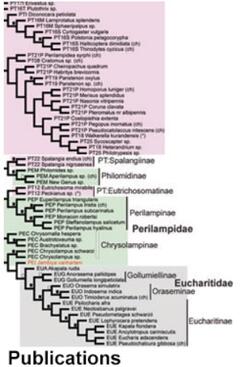
1) Phylogenetic analyses of a 600-plus taxon molecular dataset of Chalcidoidea (Hymenoptera).

2). A taxonomic and phylogenetic revision of Azotinae (Aphelinidae: Chalcidoidea).

Additional projects include:
i). Pursuing techniques to expedite alpha-level taxonomy, working in collaboration with Jason Mottern, who developed a FileMaker Pro specimen-level database and Matt Yoder, who created MX, an online database for descriptive taxonomy.

ii). Installation of cladistic analysis programs, and creation of PBS scripts and guidelines for the 64-bit LINUX Texas A & M Brazos cluster.

iii). Secondary structural model development for Hemiptera and Thysanoptera.

iv). Facilitated biological control project to introduce Cyrtobagous salviniae to control Salvinia molesta in Bermuda.

v). PDF library creation of Chalcidoidea literature with the intent to make non-copyrighted material publicly available.

CURRENT RESEARCH:
I am expanding upon one aspect of my Ph.D. research, the additin of taxa to what was a 525 sequence dataset.  This dataset represents members from all families of Chalcidoidea and five outgroup suerfamilies. Acquisition of sequence data has been a collaborative lab effort between members of the Heraty lab and is sponsored by the Chalcidoidea TWiG / Hymenoptera Tree of Life project (NSF Grant EF-0341149). The dataset includes 18S and 28S D2 through D5 rDNA, which has been aligned according to secondary structure. 76 Regions of Ambiguous Alignment sensu lato have been identified and isolated. I am investigating the impact on the hypothesized relationships when cladistic analyses are conducted with these ambiguous regions removed versus their inclusion in analyses. I am also evaluating the impact of the chosen optimality criterion on an analysis and comparing results from parsimony, maximum likelihood, and Bayesian analyses.

Since its inception, authors have debated the validity and evolutionary affinities of Azotinae (Aphelinidae: Chalcidoidea).  The subfamily Azotinae is currently considered to be monotypic, consisting of the genus Ablerus, encompassing 96 valid species.  Formerly, Azotinae was represented by 2 genera, Azotus and Ablerus, the former having been synonymized with the latter. While this synonymization is accepted by most, some authors have expressed dissatisfaction with this action.  Placement of Azotinae species within the aphelinid family group has historically been regarded as sound, although the status of the Azotinae subfamily itself, and placement of azotine species within other aphelinid subfamilies has continually been in flux.  However, within the last 15 years not only have the phylogenetic affinities of Azotinae within the family Aphelinidae been questioned, but also placement of the subfamily within the superfamily Chalcidoidea itself.  This is not surprising, considering our lack of knowledge regarding the evolutionary history of Chalcidoidea.

With these facts in mind, the goal of my research is to produce a monographic treatment of the Azotinae.  Three areas of research are proposed in this taxonomic and phylogenetic revision:

1)  Higher Level Relationships:
What is the phylogenetic placement of the Azotinae within the Aphelinidae, or for that matter, within the Chalcidoidea?  Morphological and molecular studies are being used to determine the phylogenetic affinities of Azotinae.

2)  Within Azotinae Relationships:
Was the synonymization of Azotus with Ablerus a justified action and what are the evolutionary relationships within Azotinae?  Morphological and molecular studies are being used to address these questions.

3)  Taxonomic Revision:
Just how many species are there to describe and re-describe?  Well, it turns out that there are a 'few' more than was expected!  What began as a worldwide taxonomic revision has been pared back to include New World species only.  Even still, there are at least 100 species in need of description...

Ph.D. RESEARCH:
Graduate research focused on gene homology, data alignment (manual, structural, algorithmic, and direct optimization), and phylogenetic methodology (choice of optimality criterion) and included four areas of investigation:

1. Fox Gene Family Phylogeny.    

- Published a phylogeny of Forkhead-box (Fox) gene families for vertebrate and invertebrate taxa.
- Benchmarked alignment strategies for nucleotide and translated amino acid data.
- Discussed the impact of paralogous genes in phylogenetic analysis.

2.
28S D2-D3 rDNA Secondary Structural Model.  

- Published a secondary structural model for 28S D2-3 rDNA for Chalcidoidea (Hymenoptera).
- Inferred structure from compensatory base changes of 527 taxa, including outgroup representation.
- The model has proven useful in assigning positional nucleotide homology for phylogeny reconstruction.

3. Phylogeny of Chalcidoidea.

- Applied 18S and 28S D2-5 rDNA structural models to 525 taxa representing all families of Chalcidoidea and five outgroup superfamilies.
- Identified and isolated 76 Regions of Ambiguous Alignment sensu lato (RAAs).
- Conducted analyses both with the RAAs removed or included, post alignment with the MAFFT algorithm.

4. Phylogeny of Reduviidae.   

- Published a phylogeny of Reduviidae (Heteroptera) based on mitochondrial and nuclear rDNA.
- Aligned partitioned data with multiple algorithms implemented in MAFFT.
- Evaluated the results against a published morphology-based phylogenetic study of Reduviidae.